Printable Guides
RD7200 Utility Hookup Quick Card
- Water:
- Metallic: Direct connect to valve/hydrant
- Plastic (PVC) w/ tracer wire: Red to tracer wire
- Black to ground stake
- No tracer wire: Use sonde
- Freq: 8 kHz–33 kHz
- Sewer:
- Non-metallic: Use sonde in cleanout/camera
- Metallic (rare): Direct connect
- Freq: 33 kHz or 512 Hz sonde
- Electric:
- Clamp on insulated live cable
- Alt: Direct connect to sheath/ground (if safe)
- Check passive power first
- Freq: 8–33 kHz
- Gas:
- Plastic w/ tracer wire: Red to tracer wire
- Steel main: Direct connect to valve/riser
- Freq: 512 Hz–8 kHz
- Fiber Optic:
- Armored: Clamp around sheath
- With tracer wire: Direct connect
- Freq: 512 Hz–8 kHz
- Chilled Water:
- Usually metallic: Direct connect to valve/pipe Clamp if insulated
- Freq: 8 Hz–8 k
- Reclaimed Water:
- Plastic w/ tracer wire: Direct connect
- No tracer wire: Induction
- Freq: Start low, increase if needed
- Best Practices:
- Direct connect if possible
- Ground stake 10–20 ft away, perpendicular
- Start low frequency
- Confirm with multiple sweeps & modes
Locator Reference Guide Checklist
Utility Locating Quick Reference Guide
- 1. Arrival & Safety
- Check in & review site maps
- Wear PPE (vest, hard hat, gloves, boots, glasses)
- Walk job site & identify hazards
- Plan which utilities need locating
- 2. Equipment Setup
- Inspect & power on RD7200/RD8200
- Run self-test, check batteries
- Select correct mode: Active / Passive / Induction
- 3. Hookup Steps
- Preferred order: Direct Connect → Clamp → Induction
- Red lead → Utility (metal/tracer wire)
- Black lead → Ground stake (away from other utilities)
- Start with low frequency, increase only if needed
4. Utility Locating Colors: 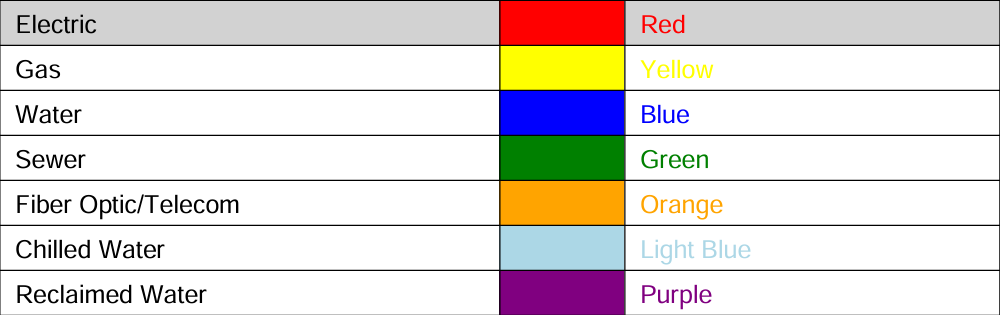
5. Locating & Marking
1. Sweep in both directions
2. Verify signal strength
3. Mark path: Flags at turns/crossings, Paint dashes + arrows
4. Depth check at critical points
- 6. Packing Up
- Disconnect transmitter & ground
- Clean & inspect equipment
- Collect flags/cones/safety gear
- Record locate (photos/Notes/Comment to Call Center)
- Report job complete
- Best Practices
- Always confirm with 2+ modes when possible
- Avoid hooking near transformers/multiple parallel lines
- Double-check crossings
- Keep marks consistent & visible